 | Strona
domowa Ireny i Zbigniewa Kuleszów
Serdecznie witamy na domowych, prywatnych serwerach
Dzisiaj jest: 2026-10-11
Aktualizacja
strony dnia: [an error occurred while processing this directive]
|  |
Rocznica
24 lat pracy serwerów i strony zjk.pl :-) (od 2002)
24
lat nieprzerwanej pracy z systemem FreeBSD / 24 years of continuous work with FreeBSD system
UWAGA!
Ten serwis, strona i podstrony mogą używać cookies i podobnych
technologii (brak zmiany ustawienia przeglądarki oznacza zgodę na to)!
FreeBSD i mikroserwery. Rocznica
18 lat pracy serwerów i strony zjk.pl :-) Nieprzerwanie od 2002 roku.
Server
Infrastructure
Zbigniew
Kulesza zjk.pl
A
warm welcome to my private, home-based FreeBSD/UNIX servers, Sieradz.
Poland
Today
is:  2026-10-11
Last update: [an error occurred while processing this directive]
2026-10-11
Last update: [an error occurred while processing this directive]
[Polski]

PLEASE
NOTE - all parameters provided on this website are NOT fiction,
theoretical simulations, or ideal scenarios. This is an absolutely
REAL, live environment that you are using while reading these words.
However, certain elements have been anonymized for security purposes.
If you doubt the authenticity of the presented data, rest assured that
I usually understate the actual figures.
Furthermore - due
to ongoing development work - in some components there may differ in
their stage of deployment (I typically wait several months to ensure a
specific technology performs stably).
Certain configuration
elements are occasionally phased out - if in doubt, please inquire via
email regarding the current status, as this website serves primarily an
illustrative purpose rather than strict documentation. Concurrently,
specific hardware parameters and historical events described in the
history do hold documented value.
The diagrams were created
independently or with the assistance of ChatGPT and Microsoft Copilot.
The texts were originally written by myself and "refined" using
ChatGPT. Translations were performed with the help of ChatGPT.
If you find any linguistic or technical errors - please report them and
forgive the oversight; keeping this server room and other
responsibilities running takes up a significant amount of my time ;P
A.
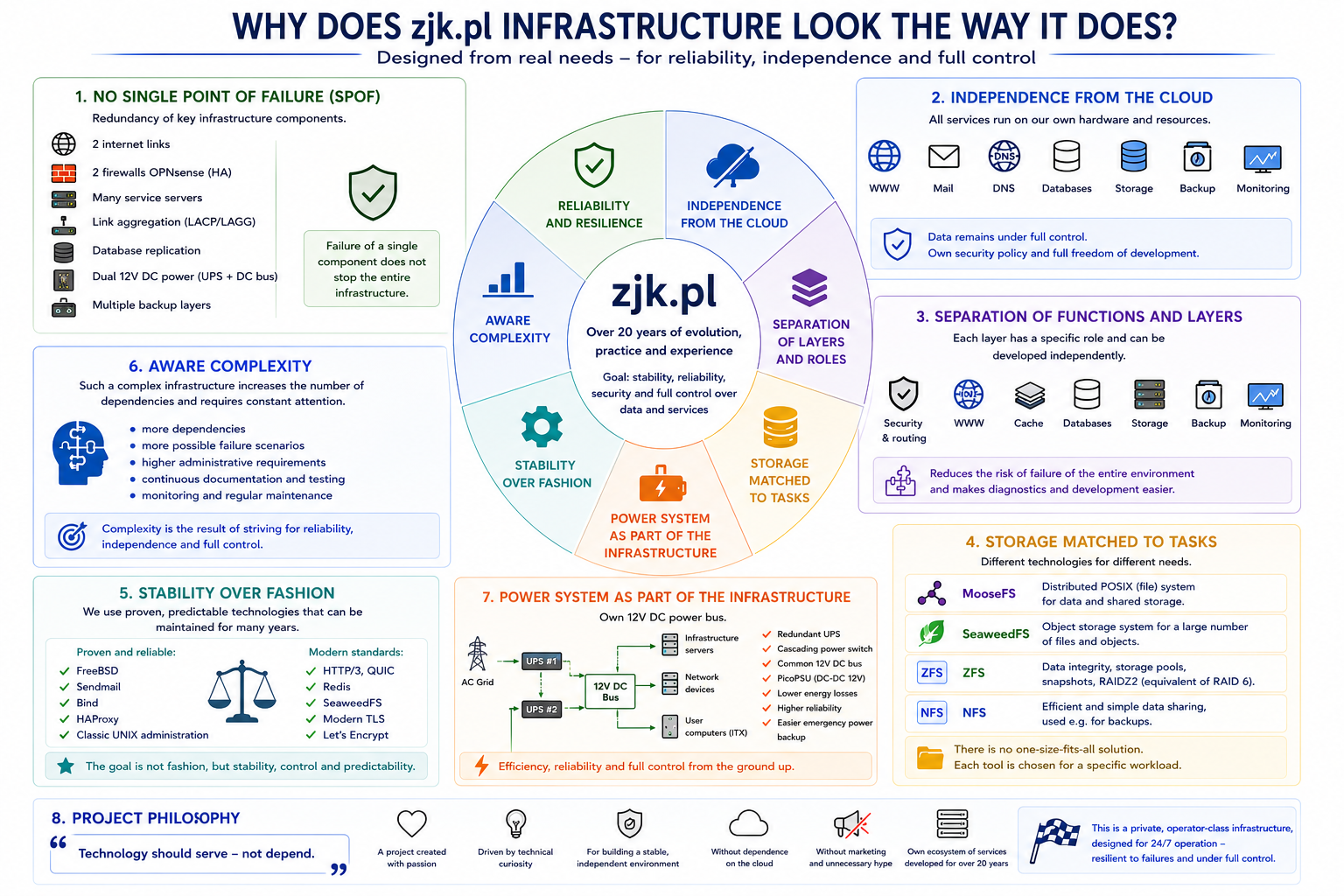
Project Philosophy:

Is
it possible to build a professional Datacenter without a corporate
cloud?
Nowadays, the web is dominated by large
corporations, advertisements, and tracking scripts. However, the
Internet can look different. For 24 years, a fully
independent, private server infrastructure, zjk.pl,
has been developed, which serves as proof that a free and secure
digital world still exists. This is not just a regular computer sitting
in a corner, but an advanced ecosystem based on the FreeBSD
system.
For people looking for inspiration,
computer science students, or technology enthusiasts, this page serves
as a practical case study. It presents how Enterprise-class solutions
function in a real environment:
Foundations
and security: Implementation of the highest website security
standards (HTTP/3, strict SSL/TLS
headers), an independent and spam-resistant mail system, and
applications isolated in secure containers (Jails).
High Availability (HA): A cluster architecture based
on the CARP protocol and the HAProxy
load balancer, eliminates downtime in service operations in the event
of hardware failures.
Storage Management: A
scalable and secure data space realized using the ZFS
file system, as well as the distributed systems MooseFS
and object-based SeaweedFS.
The following description is a unique record of the path –
from a single server to a distributed architecture. This is technical
documentation of how modern UNIX art functions in
practice.
B.
Infrastructure Parameters:
- service
availability 24/7/365, full uninterruptible power supply (UPS)
- redundancy
of selected services and infrastructure components,
- OPNsense
HA (master/slave + CARP),
- two
independent ISP connections,
- LACP/LAGG
for critical network connections,
- physical
and virtual servers,
- storage,
backup, and monitoring,
- systematic
hardware and software updates (continuous mode, reboots after essential
updates regardless of uptime),
- ability
to host own domains and services.
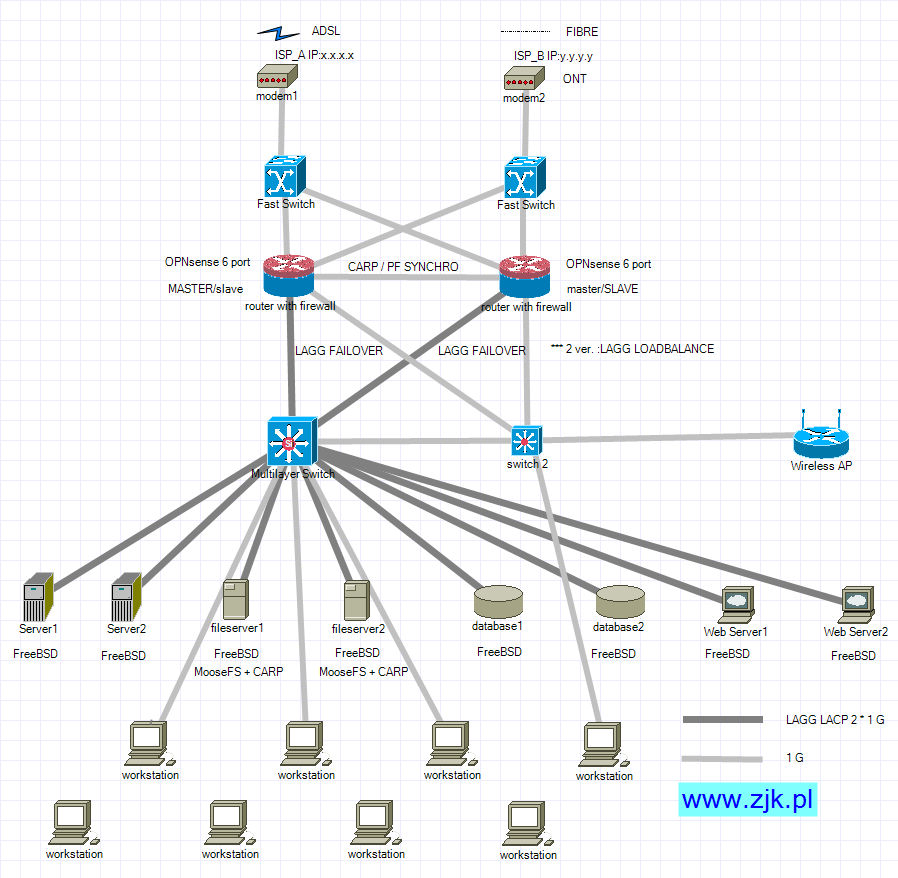
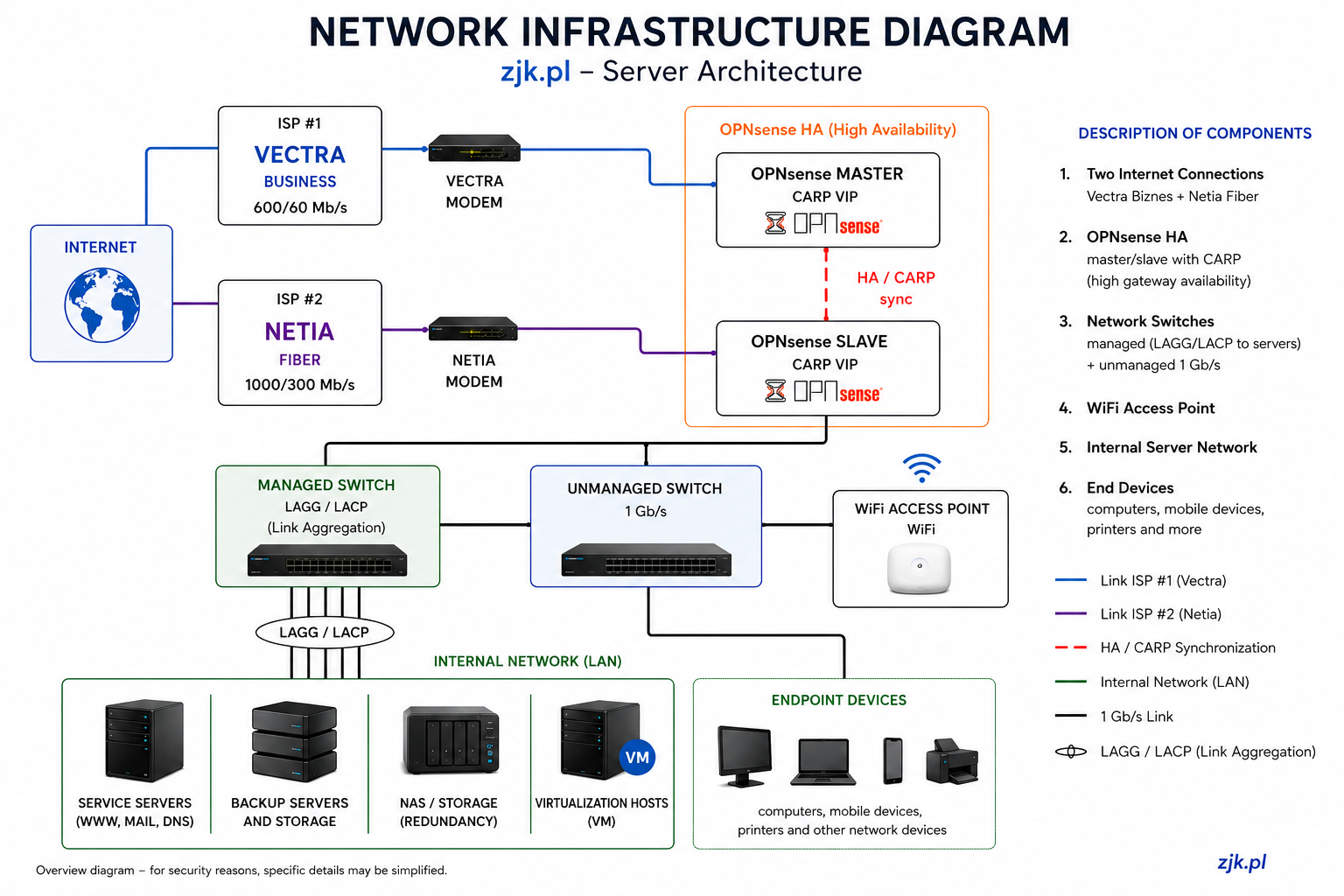
The
above diagram and the description below are for illustrative purposes
only (for security reasons).
C.
Infrastructure Architecture
The
following diagrams and descriptions are for illustrative purposes
only for security reasons.
Stable Network and
Distributed Space: Fault-Tolerant Architecture
True engineering begins where a single drive and a single server end.
Building a reliable environment requires effective management of the
growing volume of data, tying two independent ISPs, and ensuring the
continuity of service operations, even in the event of a physical
machine failure.
This chapter is a detailed
description of the topology and structure of zjk.pl. It presents an
architecture devoid of single points of failure (SPOF), where the
network layer relies on OPNsense HA (CARP) firewalls and link
aggregation via LACP/LAGG. A key element of this configuration is a
highly scalable storage, realized based on MooseFS and object-oriented
SeaweedFS. The following material documents how these advanced data
storage and replication solutions function in the daily production
practice of the cluster.
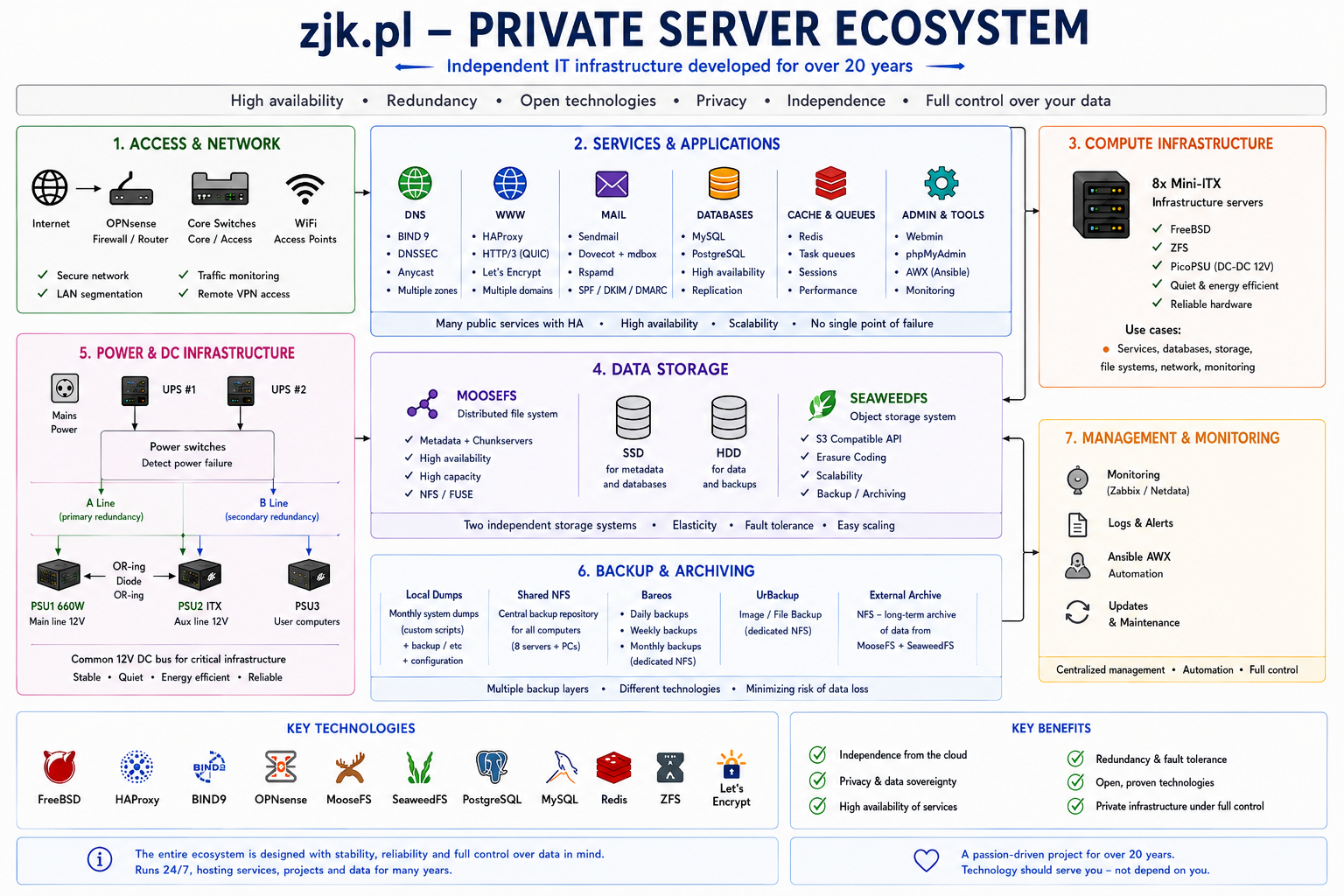
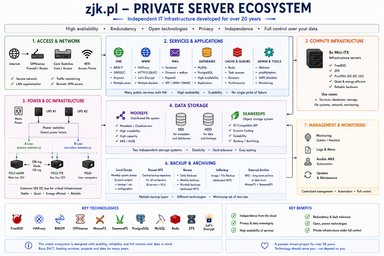
Description
of the zjk.pl server room ecosystem: "ecosystem", how zjk.pl operates
as a whole with an emphasis on the most important technologies.
D.
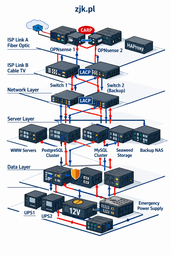
The Infrastructure Consists of the Following
Layers:
D.1
Edge Layer – communication with the world
- OPNsense
HA (master/slave),
- CARP
failover,
- two
independent ISP connections,
- routing
and automatic failover,
- firewall
/ NAT / filtering,
- HAProxy
/ reverse proxy,
- TLS
termination,
- HTTP/3
/ QUIC.
D.1.1 Edge Description:
a.
the layer consists of two modems from different Internet Service
Providers,
b. two computers with OPNsense - running CARP in
a Master-Slave configuration. The diagram illustrates this system: 2
modems (Vectra and Netia), 2 x OPNsense,
c. but it extends
to the next layer – the network: two switches (one managed
and one unmanaged) and a WiFi access point.
D.2
Network Layer – pure
transport infrastructure
- managed
switch,
- backup
switch / fallback,
- LACP
/ LAGG,
- VLAN
/ network segmentation,
- trunks
and aggregation,
- WiFi
access point,
- LAN
network.
D.2.1 Network Description:
a.
LAGG/LACP connects the servers with the managed switch at 2x1Gb/s,
b. however, in selected areas LAGG is also implemented in failover and
loadbalance modes.

D.3
Service & Application Layer (Service Layer) - offered
functionalities / services
- distributed
Web servers,
- Sendmail
mail, Dovecot,
- Nextcloud,
Piwigo,
- WordPress,
- Jellyfin,
- Git
/ SVN / Forgejo,
- monitoring
- including Monitorix, Mrtg, Ganglia, Symon,
- logging
/ syslog,
- DNS,
- application
reverse proxy,
- service
HA.
D.3.1 Mail System
Description:
a.
two mail servers mail.zjk.pl (mail1.zjk.pl) and mail2.zjk.pl, both
running Sendmail + various security tools: rspamd, Mailscanner,
spamassassin, and fetchmail along with mechanisms such as:
DKIM, SPF, openDMARC, and LetsEncrypt keys.
b. at the
client access layer, it uses dovecot with highly modern mdbox (and an
interesting detail: the mail data operates on a MooseFS-mounted
/usr/home with a separate directory for fast local indices).

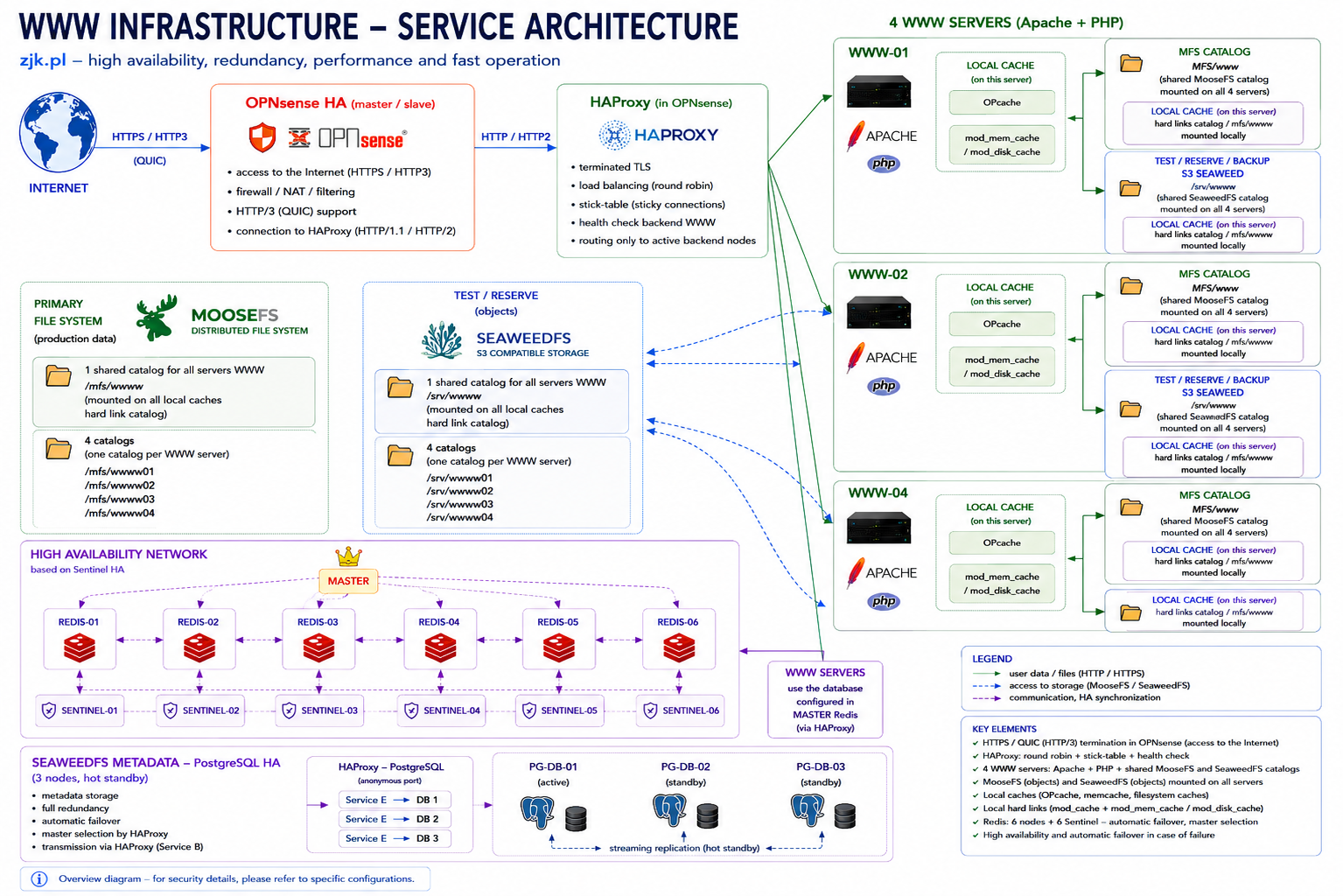
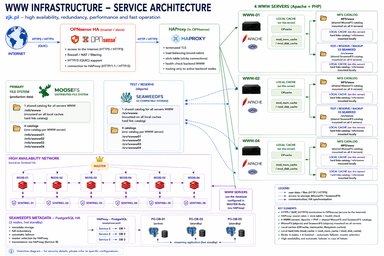
D.3.2 Web Cluster Description:
Providing
a description of the data flow:
a. data arrives
at OPNsense,
b. from there, HAproxy routes it using the
Round-Robin method with sticky connections to
c. 4
web servers (checking which one is currently available),
d.
the 4 servers utilize directories shared on MooseFS (1 server, one
directory),
e. or (test/backup mode) 4 SeaweedFS (similarly
there: 1 directory, 1 filler),
f. cache - local to
each server: opcache and the apache memory/diskcache module,
g. and redis - redis is complex, consisting of 6 machines with
one selected as master by 6 sentinels - operational synchronization
takes place via HAproxy on OPNsense, and the web servers
utilize the selected master,
h. OPNsense adds the HTTP/3
protocol (in testing phase) at its output over the UDP protocol,
i. explanation - the directories on both MooseFS and SeaweedFS are
actually a single MooseFS directory mounted on each web server, and
similarly for SeaweedFS - there is one directory, but there are 4
separate caches storing copies of this directory on each computer
individually.
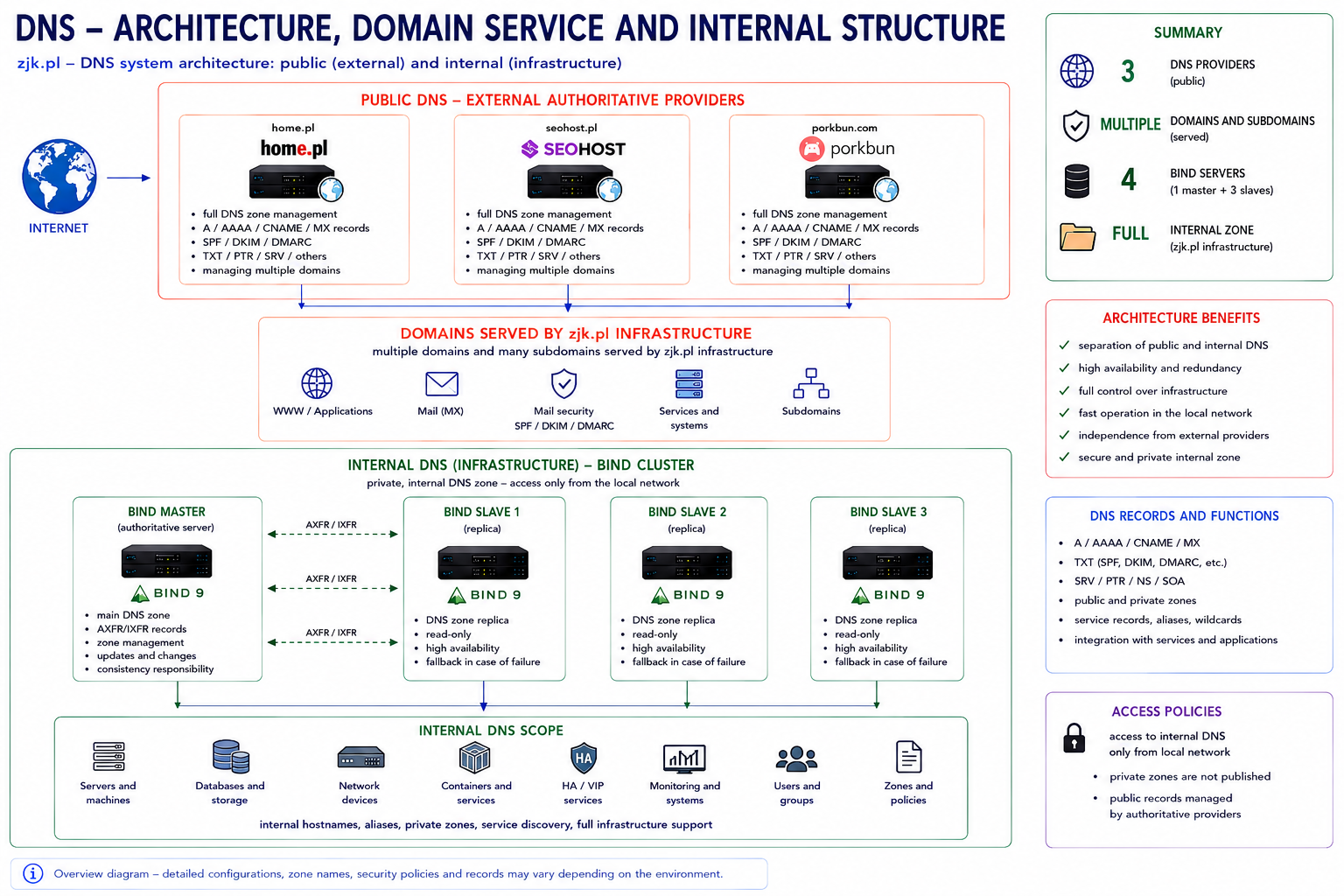
D.3.3 DNS Description:
a.
External DNS: 3 providers (home.pl, seohost.pl, porkbun.com) -
entries include not only standard records, but also SPF, DKIM, DMARC,
etc. - for several domains handled by the zjk.pl servers,
b.
Internal DNS BIND9: 4 machines: one master + 3 slaves, describing the
full diagram of the internal zjk.pl server room structure.

D.4
Storage & Data Layer - storage of
data and backend
- ZFS
+ ZFS RAID,
- MooseFS,
- SeaweedFS,
- PostgreSQL
cluster,
- MySQL
cluster,
- backup,
- data
replicas,
- object
storage,
- snapshots
and backup,
D.4.1 ZFS Description:
File
system present mainly on data storage drives (meaning MooseFS
utilizes ZFS drives, as do all archive and backup drives),
in one pool type raidz2-0 – the equivalent of RAID 6
(tolerates the failure of 2 drives).
System
drives with minor exceptions (on ZFS) are UFS2.

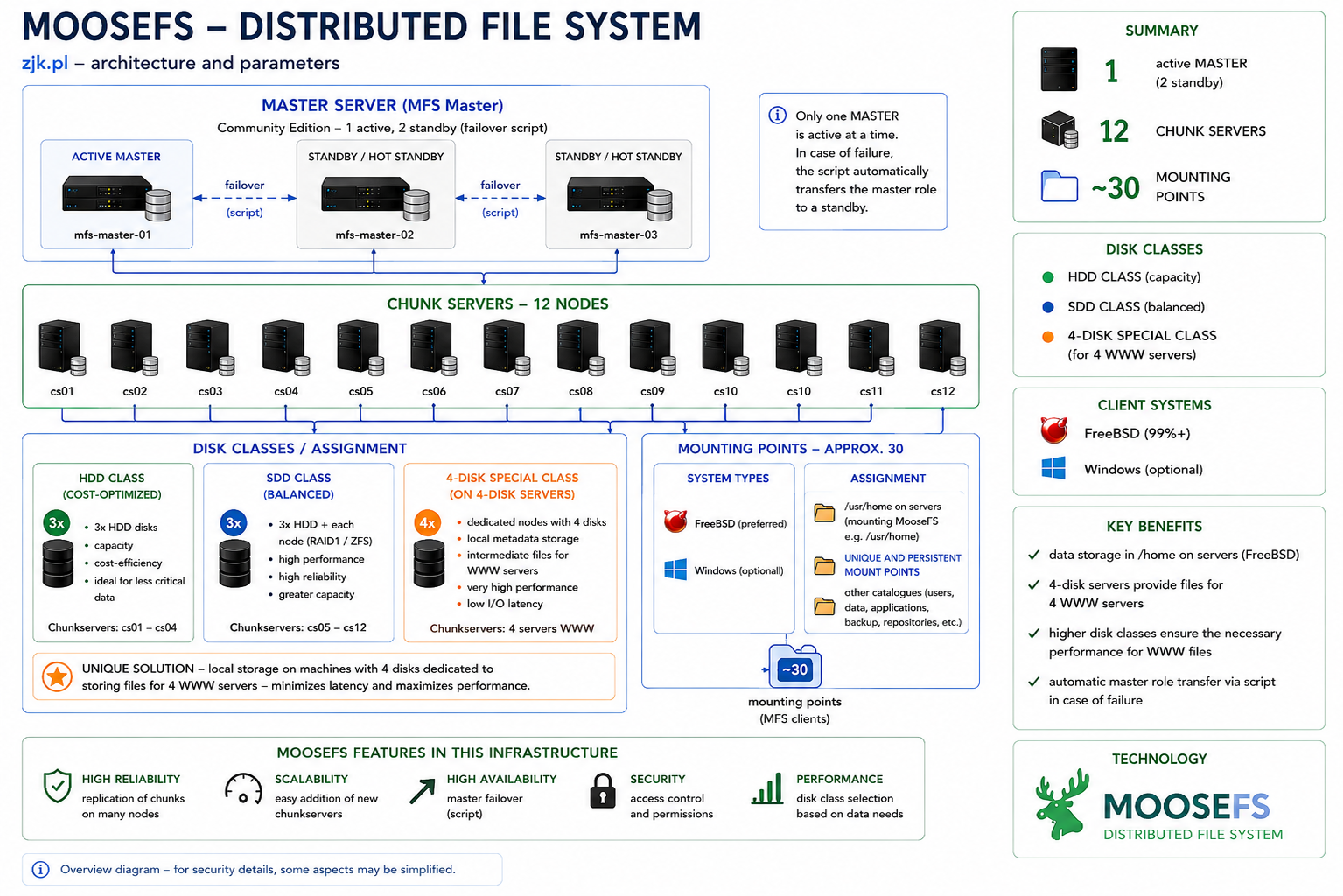
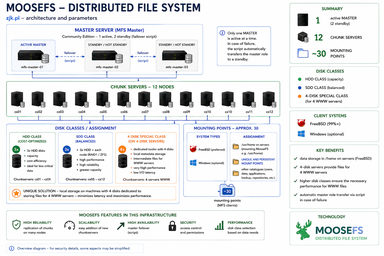
D.4.2 MooseFS Cluster
Description:
a.
1 master – this is the Community Edition version,
b. however, 2 servers can assume the master role via a script,
c. 12 chunkservers,
d. approx. 30 mount points, among which
it is worth noting – mounting the /usr/home
directory for servers (which is quite a challenging matter to
maintain), and the mount points are FreeBSD and Windows,
e. it is worth highlighting that there are HDD and SSD drive
classes (triple replication) and a special class for 4 drives, which
serve as local machines delivering files for the 4 web servers (quite
unique).
D.4.3 SeaweedFS Cluster
Description:
a. 3
masters,
b. 7 volume servers,
c. synchronized on 4 different ports separately in HAproxy on
OPNsense,
d. 4 volume servers operate for web directories,
the remaining ones are mount points with 2x and 3x replication, but
separately for fast SSDs and standard HDDs - note - the 3 main volume
servers have two HDD and SSD drives each, web volume servers have SSD
drives, making a total of 10 drives,
e. SeaweedFS stores
metadata in PostgreSQL - 3 separate servers operating in Hot Redundancy
mode, with one selected as master - the selection and data transmission
of the metadata database takes place through HAproxy running
on OPNsense.

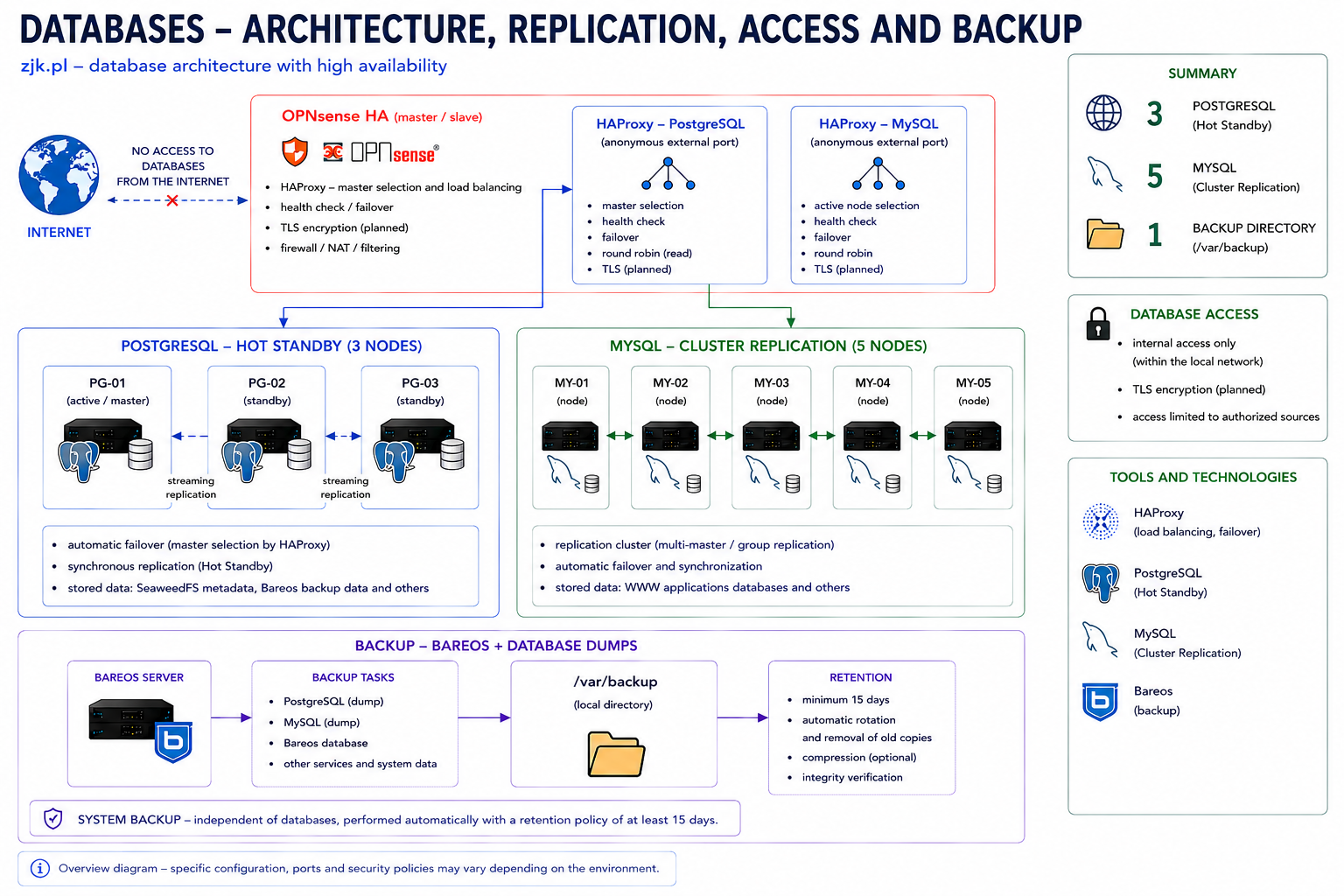
D.4.4 Databases
Description:
a.
PostgreSQL in Hot Redundancy mode: 3 servers with one selected as
master, its selection takes place via HAproxy on OPNsense - with access
to the database through a shared port on OPNsense - this
database stores SeaweedFS metadata and among others, Bareos
backup data,
b. MySQL - 5 servers in Cluster
Replication mode, communicating with OPNsense to select a
single master, while a shared port for data access is simultaneously
exposed on OPNsense. MySQL mainly provides databases for the web
servers,
c. note - databases are backed up using
native tools as dumps with a retention period of at
least 15 days.

D.4.5 Backup Description:
a.
each of the 8 servers has two drives: a main SSD and an HDD
with local dumps (created by my own script - monthly),
b. data
is sent to a shared network drive (NFS, not MooseFS),
c.
and from there to an external archive drive,
d. Bareos
backups (classic: daily, weekly, and monthly) on
separate NFS drives,
e.
Urbackup - separate NFS drive
e. MooseFS
and SeaweedFS drives are sent to the
aforementioned external archive drive,
f.
/etc and /usr/local/etc configuration backups - etckeeper (testing
phase).

D.5
User and Client Layer (Client Layer) - who
utilizes the infrastructure
- home
computers,
- laptops,
- mobile
devices,
- IoT
devices,
- test
systems,
- users'
network devices,
- workstations.
D.6
Operations & Auxiliary Systems Layer (Operations Layer)
– typically hidden in other homelabs, but showcased at zjk.pl
- monitoring,
- alerting,
- log
aggregation,
- backup
orchestration,
- automation,
- HA
scripts,
- configuration
synchronization,
- infrastructure
documentation.
D.7
Power & Reliability Layer – deserves its own
dedicated layer at zjk.pl
- UPS
#1,
- UPS
#2,
- 12
V DC distribution,
- battery
buffer,
- PSU
redundancy,
- power
monitoring,
- OR-ing
/ Schottky,
- power
failover,
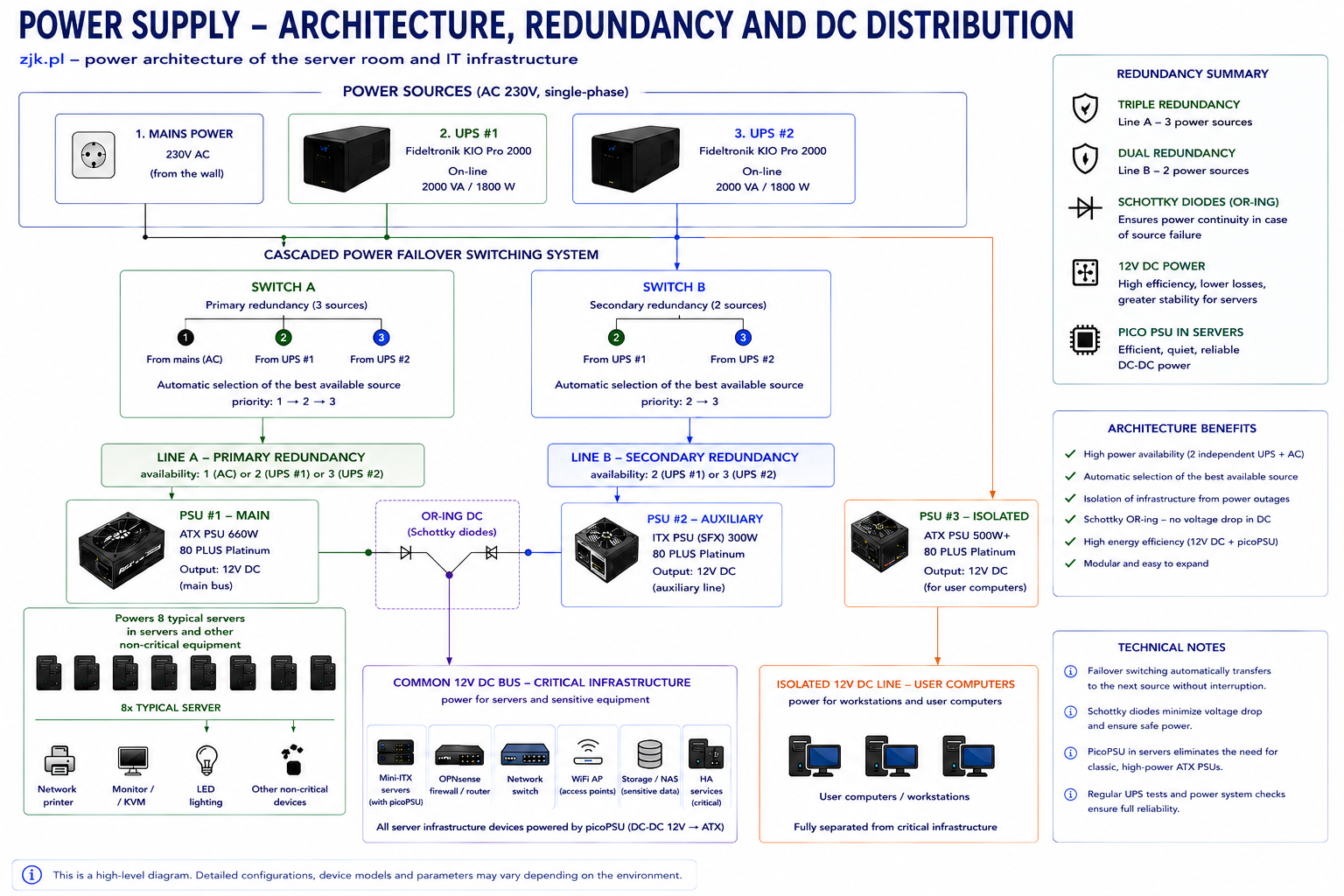
D.7.1 Power Layer
Description:
a. two
Fideltronik KI PRO 2000 UPS units,
b. their output features a dual switch that detects power loss
- meaning the power line selection is cascaded; if one UPS shuts down,
the second one takes over the load,
c. power is
delivered to two lines - one is the primary line to a 660 W
80Platinum power supply - providing the main 12 V power rail to all
servers,
d. servers (all of them) have Picopsu power
supplies on board (find the description on the Internet),
e. a second mini-ITX 80Platinum power supply generates a secondary 12 V
power line,
f. both 12 V lines combine via Schottky diodes
onto the power rail for the servers and other critical assets like
OPNsense, switch, WiFi, etc. - so that power to them is always
available,
g. a third high-power power supply generates 12
V, but only for the utility/desktop computers - so that they
are isolated.

D.8
Summary: Outstanding Technologies and Security
- FreeBSD,
- OPNsense,
- HAProxy,
- MooseFS,
- SeaweedFS,
- PostgreSQL
HA,
- MySQL
Cluster,
- Redis,
- HTTP/2
and HTTP/3,
- SPF /
DKIM / DMARC,
- security
monitoring,
- systematic
updates.
Historical name:
The former name "cookie server"
(not to be confused with modern mini-ITX cases). The English name for
subminiature computers is "biscuit computer". In Polish, "biscuit"
translates to "herbatnik" or "sucharek" (also English "rusk").
Concurrently, it can be noted that "ciasteczko" is rather the English
"cookie". However, in Polish, "herbatnikowy serwer" or "sucharkowy
serwer" sounds rather awkward... Therefore, I ultimately left it as
"ciasteczkowy serwer" (cookie server). More about these remarkably
small, low-power-consuming little computers can be found in the
"hardware" section. Welcome... PLEASE NOTE - the former "cookies" have
been replaced with more modern constructions, but also with a very low
power consumption - description also in the hardware section.
Internet
connections
The
infrastructure utilizes two independent operator connections to
increase service availability.
1. Current Internet
Service Provider - Vectra branch Sieradz - Vectra
business connection
(since
June 18, 2021): 600/60 Mb/s (which means 75 MB/s and 7.5 MB/s)
IP:
88.156.77.167 formerly 232
2. Second
connection: Netia on Orange BSA, fiber optic
(since
May 11, 2021): 1000/300 Mb/s (which means 125 MB/s and 37.5 MB/s) -
Netia promotion
IP: 83.238.166.222
The
server has its name registration at NASK, currently home.pl -
officially: zjk.pl
Copyright (c): Zbigniew Kulesza, Sieradz 2002-2026